Libra+: Compositional Interaction for Data Visualization
Xu Luo (Renmin University of China), Yue Zhao (Shandong Second Medical University), Bongshin Lee (Yonsei University), Jean-Daniel Fekete (Université Paris-Saclay, CNRS, Inria), Yunhai Wang (Renmin University of China)

Jump to Discussion
Presentation
- Session
- Please don't just stare at the picture
- Time
- Tuesday, Nov 10, 10:12 – 10:24 (US/Eastern) · session 10:00 – 11:30
- Room
- Hall America center
- Presenting from
- Tianjin
Links
Sign in to access the Paper PDF.
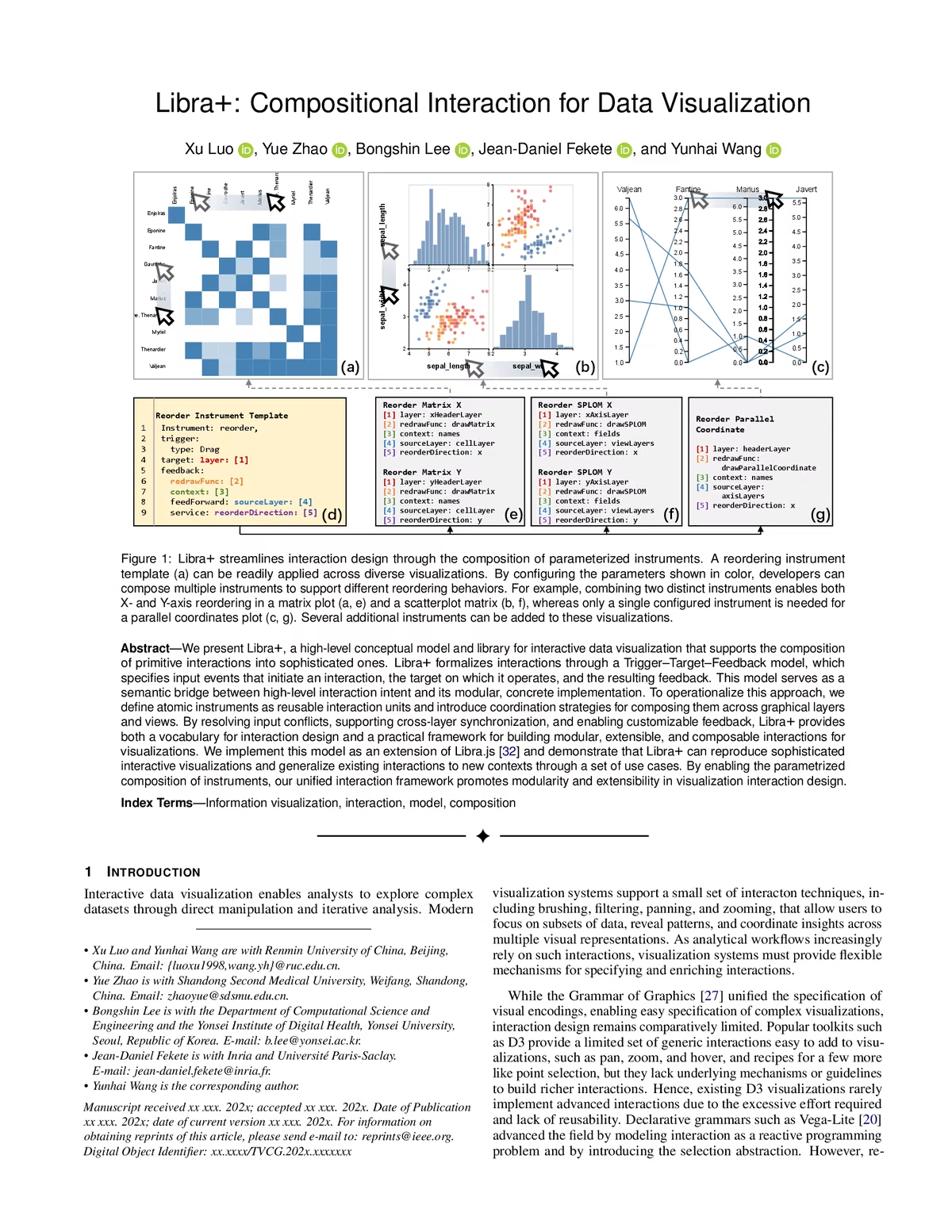
Abstract
We present Libra+, a high-level conceptual model and library for interactive data visualization that supports the composition of primitive interactions into sophisticated ones. Libra+ formalizes interactions through a Trigger–Target–Feedback model, which specifies input events that initiate an interaction, the target on which it operates, and the resulting feedback. This model serves as a semantic bridge between high-level interaction intent and its modular, concrete implementation. To operationalize this approach, we define atomic instruments as reusable interaction units and introduce coordination strategies for composing them across graphical layers and views. By resolving input conflicts, supporting cross-layer synchronization, and enabling customizable feedback, Libra+ provides both a vocabulary for interaction design and a practical framework for building modular, extensible, and composable interactions for visualizations. We implement this framework as an extension of Libra.js and demonstrate that Libra+ can reproduce sophisticated interactive visualizations and generalize existing interactions to new contexts through a set of use cases. By enabling the parametrized composition of instruments, our unified interaction framework promotes modularity and extensibility in interaction design.
For Practitioners
This paper would be of significant interest to data visualization developers, frontend engineers building analytical dashboards, UI/UX designers specialized in interactive data exploration, and tool builders in domains such as business intelligence, scientific data analysis, and data journalism.