lpviz: Interactive Linear Programming Visualization
Jump to Discussion
Presentation
- Session
- Tools of the Trade
- Time
- Thursday, Nov 12, 13:00 – 13:09 (US/Eastern) · session 13:00 – 14:30
- Room
- Hall Essex center
Links
Sign in to access the Paper PDF.
- Preprint PDF(opens in new tab)
- Supplemental Material(opens in new tab)
Abstract
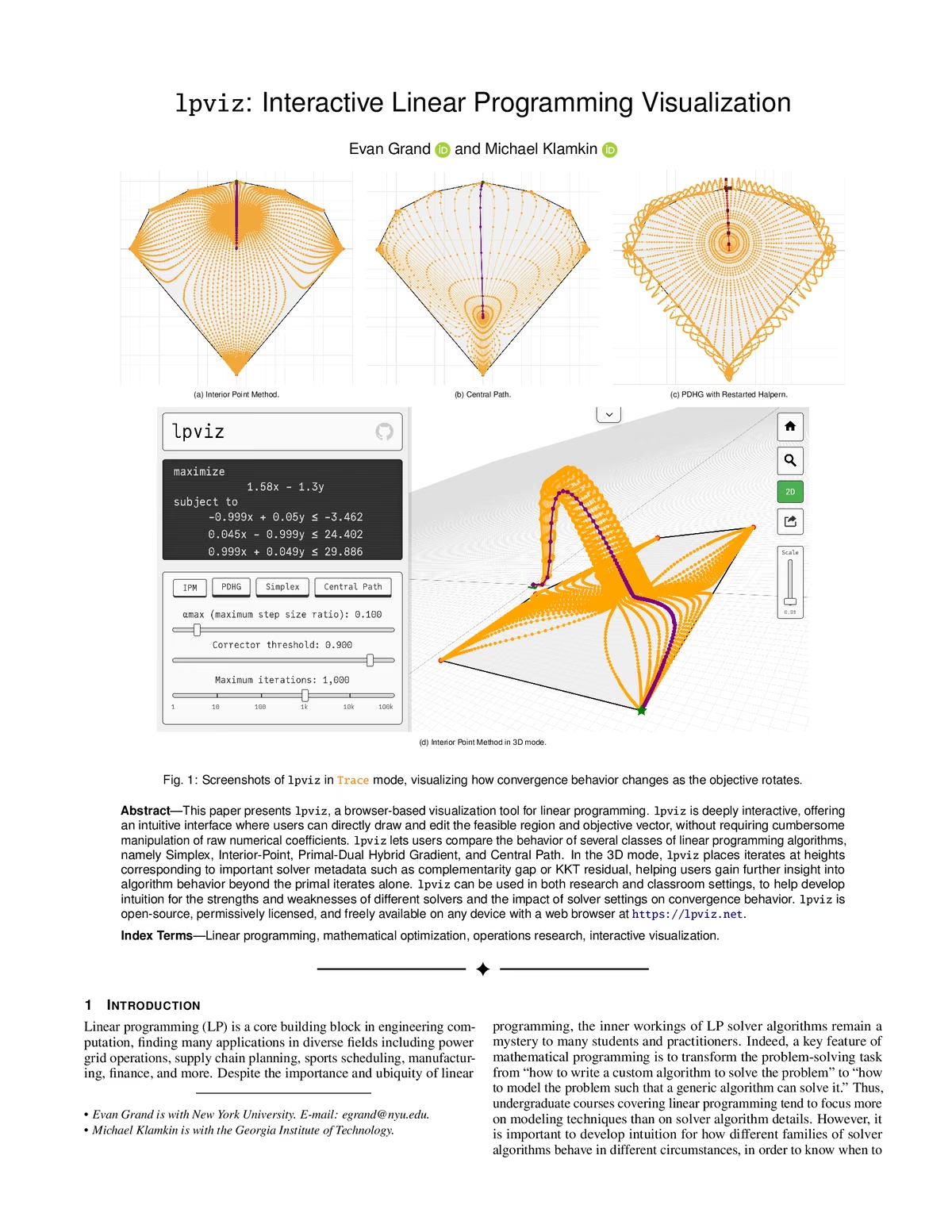
This paper presents lpviz, a browser-based visualization tool for linear programming. lpviz is deeply interactive, offering an intuitive interface where users can directly draw and edit the feasible region and objective vector, without requiring cumbersome manipulation of raw numerical coefficients. lpviz lets users compare the behavior of several classes of linear programming algorithms, namely Simplex, Interior-Point, Primal-Dual Hybrid Gradient, and Central Path. In the 3D mode, lpviz places iterates at heights corresponding to important solver metadata such as complementarity gap or KKT residual, helping users gain further insight into algorithm behavior beyond the primal iterates alone. lpviz can be used in both research and classroom settings, to help develop intuition for the strengths and weaknesses of different solvers and the impact of solver settings on convergence behavior. lpviz is open-source, permissively licensed, and freely available on any device with a web browser at https://lpviz.net.
For Practitioners
The paper is most relevant for practitioners that teach, use, or develop linear programming solvers, to communicate or gain intuition for how the underlying algorithms work. The advanced features described in the paper such as 3D mode and detailed solver settings help gain further insight into how these parameters impact the convergence behavior and thus real-world performance of the solver algorithms. More broadly, the paper underscores the importance of careful attention to implementation and performance details when building public-facing visualization applications. In particular, browser-based tools, especially those available on the internet, offer immediate usability and broad hardware support, though it may be less straightforward to achieve high performance for computationally-intense applications.